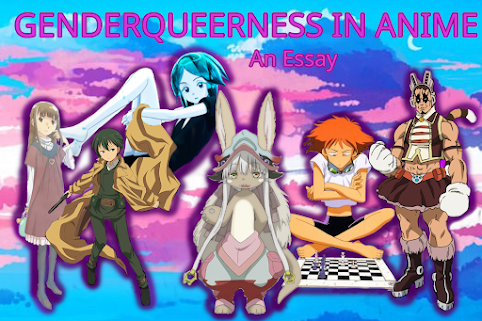
[Content warning: discussion of transphobia/queerphobia and brief discussion of child abuse.
Also spoiler warning for the following: Made in Abyss (anime and manga), Soul Eater, Steins;Gate, No.6, Kino’s Journey (2017), Land of the Lustrous, Zombieland Saga, Carole & Tuesday, Gatchaman Crowds, Princess Jellyfish, Vision of Escaflowne, Hunter x Hunter (2011), Cowboy Bebop, A Silent Voice, and Kaiba.]
Introduction: The Otaku Gender
Animation, as a medium, often skews towards the fantastical.
This is as true for Western animation as it is for anime, although since the former is generally aimed at children, and also because of the West having a long history of stringent media censorship on ‘moral’ and religious grounds, it tends to be subject to far more scrutiny than its Japanese counterpart.
To a certain extent you could say this might no longer be the case - we do live now in a post-Steven Universe world, after all. Plus, as YouTuber Jack Saint discussed in his two-part series, pockets of semi-explicit queer representation (of varying degrees of quality) can even be found in Western cartoons as far back as the late 90s and early 00s.
Still, I personally feel that anime is somehow unique in its reputation for being able to depict virtually anything, for pushing the boundaries and for embracing all that is non-normative or traditionally seen as bizarre. As you probably know, this aspect of the medium doesn’t always lead to positive things, but it makes for tons of interesting discussion from the perspective of queerness and gender, and is one of the reasons (for better or worse) why it’s my favourite medium.
That, and the fact that I’m a gigantic weeb.
Another interesting thing about anime in particular is how the process of translation contributes to an audience’s perception of a character. Gendered Japanese is a very intricate beast and a lot of its nuances have no real counterpart in English, which can sometimes lead to the erasure of a character’s identity (whether done with malicious intent or not).
That being said, calling it ‘gendered’ Japanese is actually a slight misnomer, and there also many instances of unambigiously cisgender characters employing ‘unorthodox’ speech patterns for their gender, often as a way of expressing some other characteristic independent from their identity. As such, in some cases, there isn’t always a correct answer of how it should be translated. A more detailed breakdown of how gendered language works in Japanese can be found in this great article - don’t worry, I’ll be explaining all this as it becomes relevant, but you can never really have too much knowledge if you ask me.
Anyway, I should probably explain exactly what I mean when I say ‘genderqueer’ here. Having seen the thumbnail you may already have some objections readied in your throat, but while I’m aware not all trans and nonbinary people like to identify themselves with the term, I couldn’t think of another word that fully encapsulates the broad spectrum of identities that I wanted to talk about.
Transgender, nonbinary, gender-nonconforming, crossdresser - all of these labels, for the purposes of this essay, fall under the banner of ‘genderqueer’. In other words, I’m just using it as a way to refer to any character I think is interesting to discuss from this angle, whether their identity is explicitly stated or not.
And you’re of course free to disagree with any of my takes. Queer fandom and headcanons are obviously not the sole arbiter of how any single character should be read, but I still think it’s worth discussing, even if it happens to be the case that I’m just being a representation-starved dog begging for scraps.
Now, after that lengthy disclaimer, I think it’s finally time to take a genderqueer eye to some of these characters.

